A Summer in Fontainebleau
In the summer of 1921, Pablo Picasso retreated from Paris to the quiet countryside of Fontainebleau, renting a villa just beyond the capital’s bustle. Known for its grand royal palace and sprawling forests, Fontainebleau—now a UNESCO World Heritage site—offered the perfect blend of history, solitude, and inspiration. The palace itself, dating back to the 16th century, reflects a rich fusion of French and Renaissance design—an apt backdrop for an artist constantly reinventing tradition.
What followed was one of the most productive and fascinating periods of Picasso’s career.
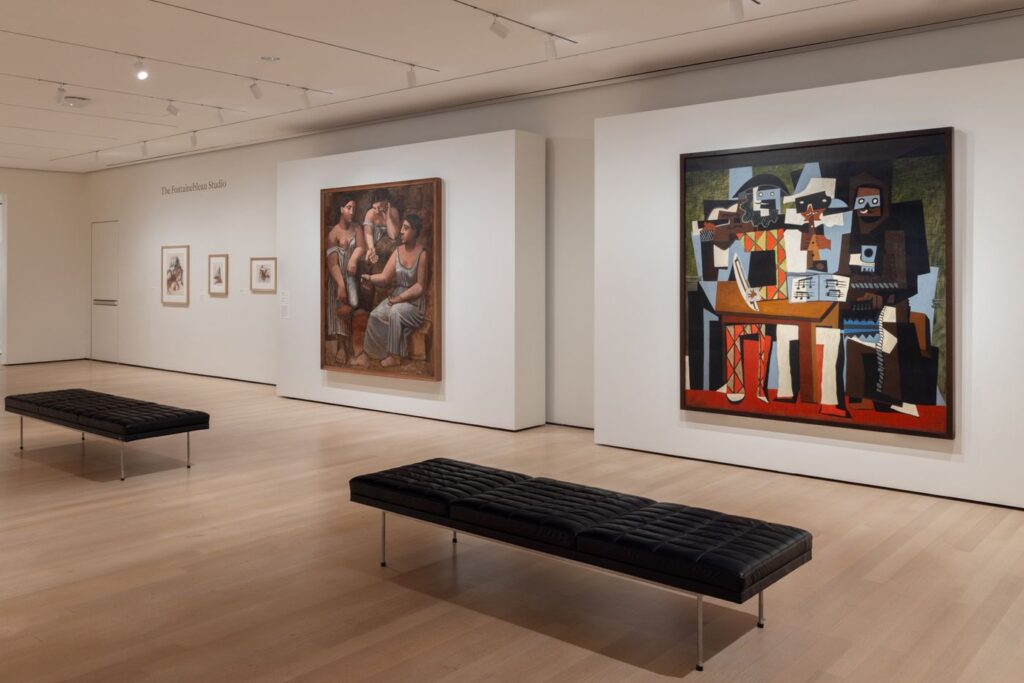
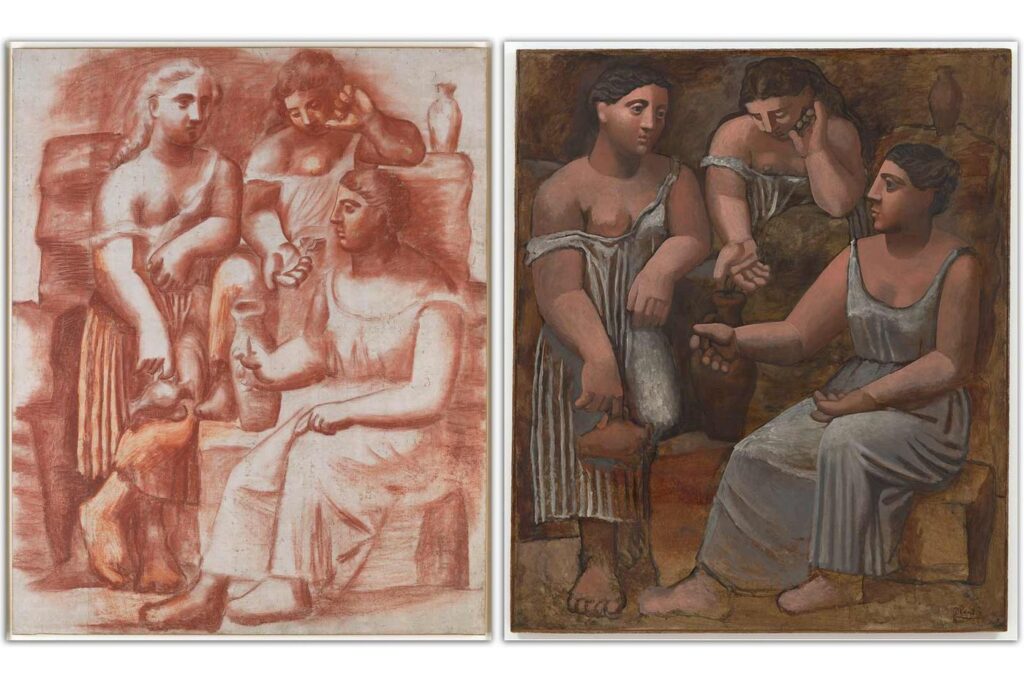
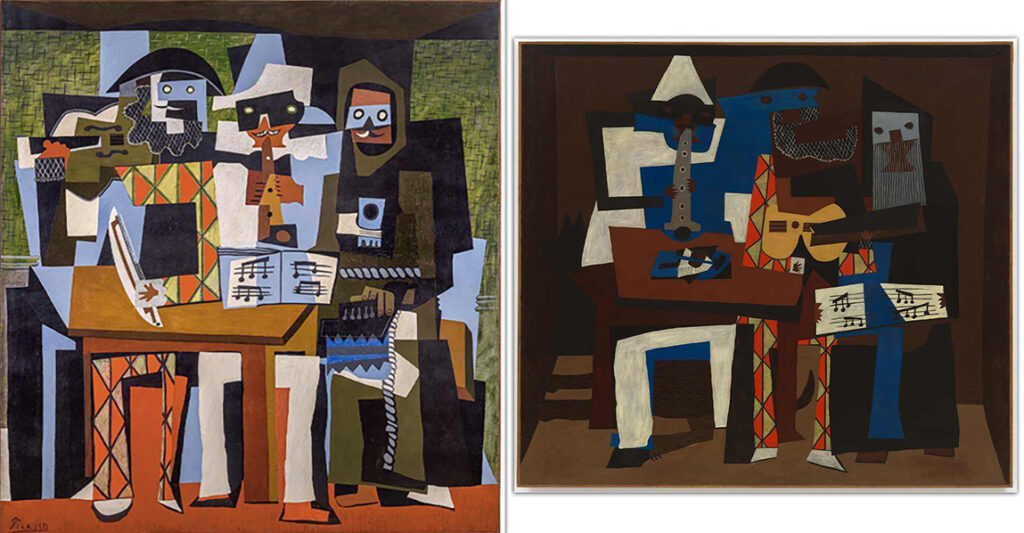
Over just three months, he created more than 80 works—paintings, drawings, prints, and pastels. Remarkably, much of this creative explosion took place in a modest 10-by-20-foot garage. It was in this unlikely studio that Picasso produced four of his most important masterpieces: two versions of Three Musicians and two of Three Women at the Spring.
At first glance, these pairings share similarities—large scale, bold compositions, and flattened forms. But look closer, and a striking contrast emerges. Three Musicians embodies the fragmented, dynamic language of Cubism, while Three Women at the Spring reflects a return to classical order and harmony. In Fontainebleau, Picasso wasn’t just creating—he was exploring two radically different artistic worlds at once.
Three Women At the Spring
In Three Women at the Spring, Picasso turned toward Neoclassicism—a style rooted in the ideals of ancient Greece and Rome. This movement emphasized clarity, balance, and emotional restraint, emerging in part as a reaction against the ornate excess of the Rococo period.
Picasso created two versions: one in oil, the other in red chalk on canvas. Both feature an earthy, subdued palette and a quiet sense of monumentality.
The figures in the oil painting feel almost architectural—solid, column-like forms reminiscent of ancient temples or Parthenon sculptures. There is a calm, timeless stillness here, echoing the work of Nicolas Poussin.
By contrast, the red chalk version feels more intimate and exploratory, recalling the preparatory “cartoons” used by Renaissance masters. Its flowing lines and subtle modeling evoke artists like Leonardo da Vinci.
Picasso was not alone in this post–World War I return to classical ideals. Artists such as Georges Braque and Henri Matisse also embraced aspects of Neoclassicism during this period, seeking stability after the upheaval of war.
Three Musicians
If Three Women at the Spring is calm and grounded, Three Musicians is its vibrant, chaotic counterpart.
These two large-scale paintings—each over 40 square feet—are among Picasso’s most iconic Cubist works. Brightly colored shapes interlock and overlap like pieces of a puzzle, creating a sense of movement and rhythm within an otherwise static composition. The figures seem to fold and unfold before your eyes, a hallmark of Synthetic Cubism.
The same trio appears in both versions:
- A white-clad clarinetist, the melancholic clown Pierrot
- A Harlequin in a bold diamond-pattern costume, playing a stringed instrument
- A robed monk
But beneath the theatrical surface lies something more personal. The figures are widely believed to represent Picasso and his circle:
- Pierrot as the poet Guillaume Apollinaire
- The Harlequin as Picasso himself
- The monk as poet Max Jacob
What appears playful and decorative is, in fact, layered with memory, identity, and loss.
.
104 Years Later
More than a century has passed since Picasso’s summer in Fontainebleau, yet these four works continue to captivate and puzzle viewers.
Why did Picasso create two pairs of paintings that are so stylistically different, yet conceptually linked? One theory suggests he was exploring the deep connection between classical form and Cubist abstraction—two seemingly opposing approaches that may, in his hands, be more closely related than they appear.
Whether or not that connection can be fully explained, one thing is certain: these works remain among the most powerful expressions of Picasso’s genius.
Today, Three Musicians can be seen at the Museum of Modern Art and the Philadelphia Museum of Art. The two versions of Three Women at the Spring are housed at MoMA and the Musée National Picasso-Paris.